The Tao Te Ching
The Tao Te Ching, also called the Laozi, is traditionally attributed to Laozi and runs to about five thousand characters. Received editions divide it into 81 chapters, the first 37 forming the 'Tao' part and the remaining 44 the 'Te' (virtue) part. The 81-chapter division and the chapter headings come from later editors and are not the earliest form of the text. Modern scholars still debate its authorship and date, and many think the text took shape over a long period.
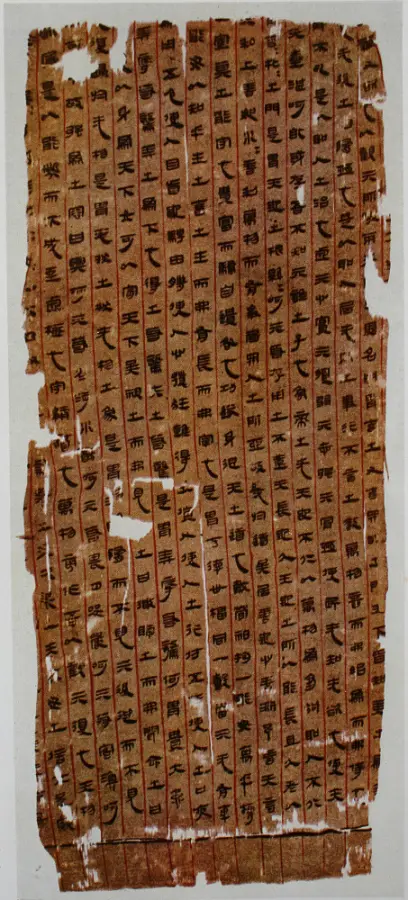
Twentieth-century archaeology transformed the field. In 1973 two silk manuscripts of the Laozi were found in a Han tomb at Mawangdui, Changsha, sealed around 168 BCE, and they place the 'Te' part before the 'Tao' part. In 1993 bamboo slips of the Laozi were found in a Chu tomb at Guodian, Hubei, dated to roughly the middle Warring States period. They contain only part of the received text and are among the earliest known witnesses.
'The Tao that can be told is not the constant Tao'
What can be put into words is not the unchanging Tao (chapter 1).
'The highest good is like water'
Water benefits all things without competing with them (chapter 8).
'A journey of a thousand miles begins beneath one's feet'
Great undertakings begin with a single step (chapter 64).
'To know others is wisdom; to know oneself is enlightenment'
Understanding others is intelligence, but understanding oneself is true clarity (chapter 33).
Core Texts
Beyond the Tao Te Ching, several other works form the base of Taoist thought and practice. They differ in age and character, ranging from the philosophical books of the pre-Qin masters to religious scriptures that took shape after the Han.
Zhuangzi
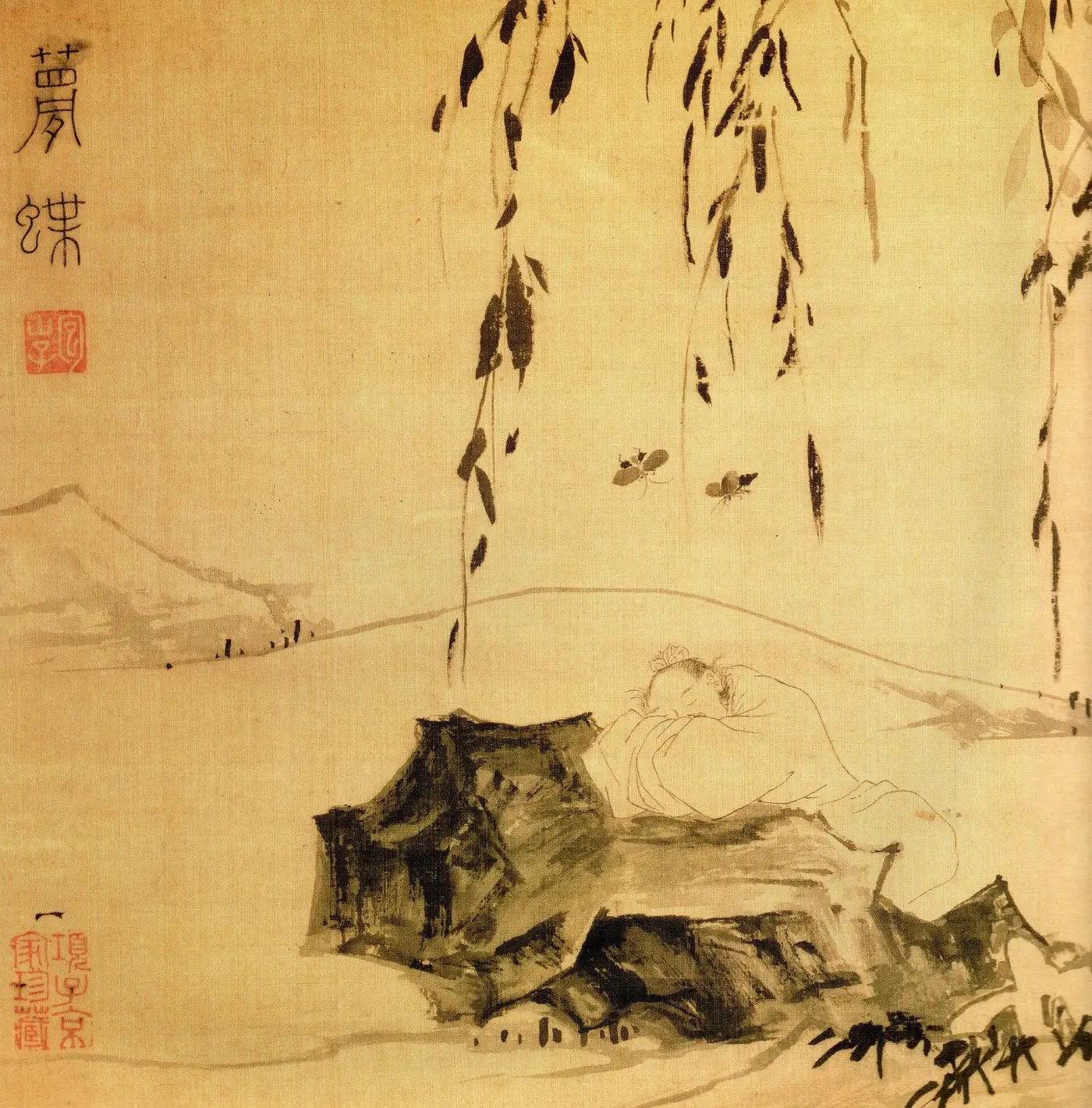
Writings of Zhuang Zhou and his later followers from the Warring States era. The received text, edited by Guo Xiang of the Jin dynasty, has 33 chapters in Inner, Outer and Miscellaneous parts, and the Inner chapters are generally taken to reflect Zhuangzi's own thought. In the Tang it was honored as the Nanhua zhenjing.
Liezi
Traditionally attributed to Lie Yukou of the Warring States era, and honored in the Tang as the Chongxu zhenjing. Many scholars think the surviving text was edited relatively late, perhaps in the Wei-Jin period.
Qingjing jing (Classic of Purity and Tranquility)
A short text of only a few hundred characters on stillness, letting go of desire and contemplating emptiness. It is generally thought to date from around the Tang and is a staple of daily Quanzhen devotion.
Huangting jing (Yellow Court Classic)
Divided into 'Inner' and 'Outer' versions, it is an early Taoist text on visualization and the cultivation of life, closely tied to the Shangqing tradition of the Six Dynasties. Its small-script manuscripts are also famous in the history of calligraphy.
Duren jing (Scripture of Salvation)
Fully titled Lingbao wuliang duren shangpin miaojing, it is a Lingbao text from the Six Dynasties, widely used in Taoist liturgy and highly regarded in the canon.
The Taoist Canon
The Daozang, or Taoist Canon, is the great collection of Taoist writings. The surviving Zhengtong Daozang was completed in 1445, in the Zhengtong reign of the Ming dynasty, and is traditionally counted as 5,305 juan (fascicles). In 1607, in the Wanli reign, a supplement of 180 juan was added. The canon includes scriptures and also works of the philosophers, medicine, self-cultivation, alchemy and ritual, making it a rich resource for the history of Chinese religion, philosophy and science.
The canon follows the 'Three Caverns and Four Supplements' scheme. The Three Caverns are Dongzhen, Dongxuan and Dongshen, linked respectively to the Shangqing, Lingbao and Sanhuang scriptural traditions. The Four Supplements are Taixuan, Taiping, Taiqing and Zhengyi, which broadly relate to the Tao Te Ching, the Taiping jing, alchemical texts and Zhengyi texts. Each Cavern is further divided into twelve categories, such as basic texts, talismans, diagrams, genealogies, precepts and liturgical texts. In the 1920s the Commercial Press in Shanghai issued a photolithographic reprint of the copy held at the White Cloud Temple in Beijing, which made it widely available.
Morality Books
Taoism has long used 'morality books' (shanshu) to encourage good conduct. The most influential is the Taishang ganying pian (Treatise of the Exalted One on Response and Retribution), which is generally thought to have begun circulating in the Southern Song. Its central idea is that fortune and misfortune have no fixed gates, and that people invite them through their own deeds. It lists many rules of conduct and was printed, annotated and copied countless times, becoming an important text of popular ethics.
The Wenchang dijun yinzhi wen (Essay on Hidden Virtue) is attributed to Wenchang Dijun and urges readers to do good in secret and help others. It circulated widely in the Ming and Qing. Historically, such books served to spread ethical teaching among ordinary people. Today they can be read as windows onto traditional values and popular religion, without any expectation of supernatural guarantees.
How to Start Reading
Beginners need not start with the enormous Daozang. Begin with the Tao Te Ching: pick an annotated modern translation, read it through once beside the original, then return to a few chapters for slow reading. D. C. Lau's Penguin translation is a good English choice, and Chen Guying's annotated edition is a good Chinese one.
Next, read the seven Inner chapters of the Zhuangzi to enjoy its parables and imagination; Burton Watson's translation is a trusted English version. Then try a short scripture such as the Qingjing jing to see what daily recitation looks like. For the larger picture, turn to general works such as Qing Xitai's history of Chinese Taoism or Livia Kohn's Daoism Handbook. Throughout, place each text in its historical setting and compare different translations and commentaries.
References
- Ren Jiyu, ed., Daozang tiyao (Synopsis of the Taoist Canon), China Social Sciences Press.
- Kristofer Schipper and Franciscus Verellen, eds., The Taoist Canon: A Historical Companion to the Daozang (University of Chicago Press, 2004).
- Qing Xitai, ed., Zhongguo daojiao shi (History of Chinese Taoism), Sichuan People's Publishing House.
- Livia Kohn, ed., Daoism Handbook (Leiden: Brill, 2000).