The Taoist Pantheon
The Taoist pantheon was never designed in one stroke. It built up in layers: early Taoism absorbed older Chinese beliefs in heavenly, earthly and ancestral spirits, along with star worship and veneration of sages. After the Six Dynasties, Taoist masters organized these figures into a graded hierarchy, and from the Tang and Song onward the tradition welcomed many popular deities as well.
Scholars often distinguish between 'revered deities' (zunshen) and 'popular deities' (sushen). The former appear in Taoist scriptures and stand at the center of Taoist ritual, like the Three Pure Ones and the Four Sovereigns. The latter usually began in folk belief, often as deified historical persons or local protectors, and were later adopted into Taoist ritual and genealogies. The line between the two is not sharp, and many folk gods were both honored by the imperial court and absorbed by Taoism.
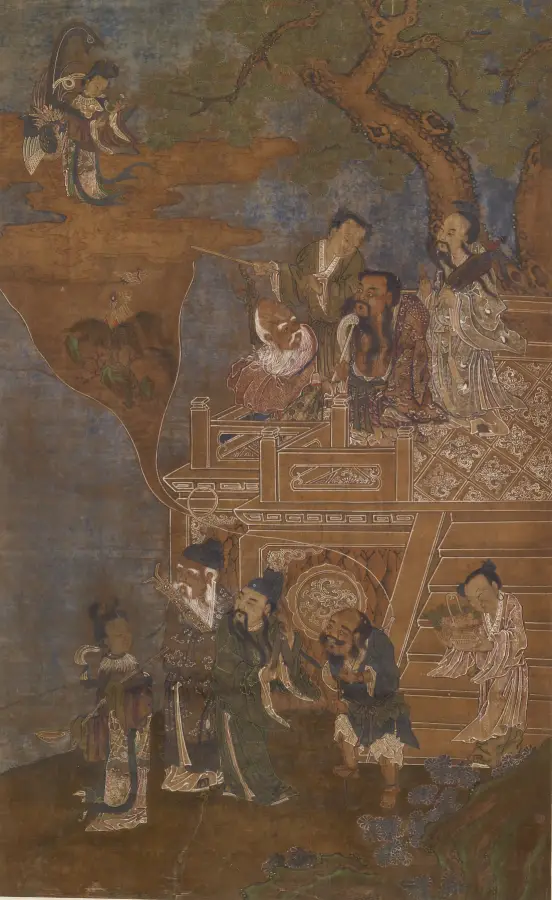
The Three Pure Ones
The Celestial Worthy of the Primordial Beginning, the Celestial Worthy of the Numinous Treasure, and the Celestial Worthy of the Tao and Its Virtue form the highest triad. The last is the deified Laozi (Taishang Laojun).
The Jade Emperor
Rising in importance during the Tang and Song dynasties and honored by the Song court, he became the popular image of the supreme ruler of Heaven.
The Four Sovereigns
Usually listed as the Jade Emperor, the Great Emperor of the Purple Tenuity of the Northern Pole, the Great Emperor of Gouchen, and the Earth Sovereign (Houtu), who assist the Three Pure Ones in governing heaven and earth.
Star deities
The Northern and Southern Dippers and Wenchang Dijun come from ancient star worship. Wenchang, associated with literary success, was especially revered in the age of the civil service examinations.
City God and Earth God
The City God grew out of rites to city walls and moats, and the early Ming court standardized his cult. The Earth God descends from ancient rites to the soil and is the nearest to everyday village life.
Mazu
Traditionally said to be a woman surnamed Lin from Meizhou in Putian, Fujian, during the Song dynasty, she became a protector of seafarers. Successive courts conferred titles on her, and her cult spread with maritime trade and migration.
Guan Yu (Guandi)
Based on the Three Kingdoms general Guan Yu, he was honored by courts from the Song onward and reached great prominence in the Ming and Qing as a symbol of loyalty and courage, and was also taken into Taoist ranks.
The Eight Immortals
Li Tieguai, Zhongli Quan, Zhang Guolao, Lü Dongbin, He Xiangu, Lan Caihe, Han Xiangzi and Cao Guojiu. The settled lineup emerged in Yuan and Ming literature and drama and became the best-loved group of popular immortals.
Stories from History
Taoism has gathered many stories over the centuries. Some rest on reliable documents, and others are legend. Here are a few, each with a note on where it comes from and how far it can be trusted, so that readers can tell history from tradition.
Laozi leaves through Hangu Pass
According to the Shiji (Records of the Grand Historian), Laozi saw the decline of the Zhou house and departed. At the pass, the gatekeeper Yin Xi asked him to write a book. Laozi wrote a work in two parts of more than five thousand characters on the Tao and its virtue, then left and was not seen again. This is the classic account of how the Tao Te Ching came to be, though scholars debate its details.
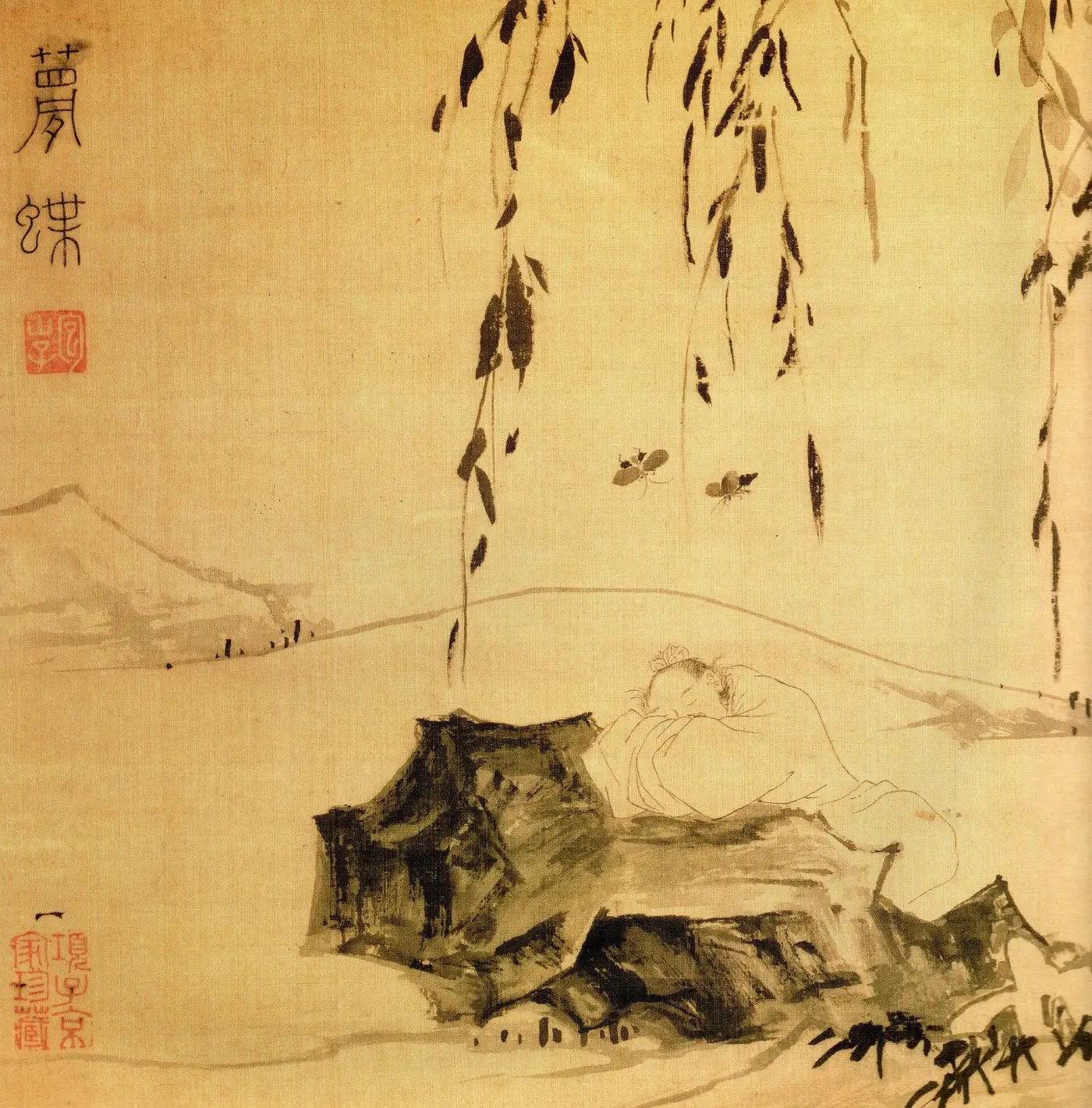
Zhuangzi's butterfly dream
In the 'Qiwulun' chapter of the Zhuangzi, Zhuang Zhou dreams he is a butterfly. On waking he cannot tell whether he was Zhou dreaming of a butterfly or a butterfly dreaming of Zhou. The parable is a famous meditation on reality, illusion and the boundaries of the self.
Ge Hong and sweet wormwood
The Eastern Jin writer Ge Hong's Zhouhou beiji fang mentions soaking a handful of qinghao (sweet wormwood) in water, wringing out the juice and drinking it. Tu Youyou has said this passage encouraged her to try low-temperature extraction in her antimalarial research, and she received the 2015 Nobel Prize in Physiology or Medicine. It is a well-known case of an ancient text offering a lead to modern science.
Qiu Chuji's journey west
In 1219 Genghis Khan sent for the Quanzhen master Qiu Chuji. Qiu set out from Shandong in 1220, in his seventies, and met the Khan in 1222 in what is now Afghanistan. His disciple Li Zhichang recorded the trip in Changchun zhenren xiyou ji, an important source for early Mongol history and the geography of Central Asia.
Alchemy and gunpowder
Taoist alchemists worked with sulfur, saltpeter and other minerals. Tang-era alchemical writings such as the Zhenyuan miaodao yaolue warn that mixing sulfur, realgar and saltpeter with honey can ignite. Many historians of science link the invention of gunpowder to alchemical experiments, though the exact path remains hard to reconstruct.
Cultural Influence
Taoism and the Daoist philosophical tradition behind it are among the main sources of Chinese culture. Alongside Confucianism and Buddhism, they have shaped Chinese ideas of the world, taste in art and everyday life. A brief survey by field follows.
Philosophy
Ideas like 'following nature' (ziran), 'non-action' (wuwei) and 'equality of things' shaped the Wei-Jin school of Mysterious Learning, and Neo-Confucian cosmology also drew on some Taoist concepts.
Literature and poetry
Li Bai's poetry is full of immortal wanderings and mountain scenes, and he himself received Taoist registers and kept company with Taoist priests. His 'Dream Journey to Mount Tianmu' is a showpiece of his romantic style. The fables and imagination of the Zhuangzi have long fed Chinese writing.
Painting and aesthetics
The Taoist love of nature, empty space and suggestion left a deep mark on landscape painting, on the prized 'untrammeled' style, and on garden design.
Medicine
Taoist figures like Ge Hong and Tao Hongjing wrote on medicine, for example the Zhouhou beiji fang and the Bencao jing jizhu, and hold a place in the history of Chinese medical literature. This is a cultural-historical note, not medical advice.
Early chemistry and science
Alchemy accumulated practical knowledge of minerals, metallurgy and chemical reactions. Joseph Needham studied it at length in Science and Civilisation in China and treated it as an early ancestor of chemistry.
Martial arts and taijiquan
Wudang martial arts have regional and cultural ties to Taoism, and taijiquan theory borrows the concepts of taiji and yin-yang. Scholars disagree on its origins, and the story that Zhang Sanfeng created it is generally regarded as legend.
Festivals and folk customs
The Taoist 'Three Origins' (Upper, Middle and Lower) are linked to the Lantern Festival, the Zhongyuan festival and related customs, and the Kitchen God, Door Gods and City God are woven into the folk calendar.
Idioms and language
'The highest good is like water' and 'a great vessel takes long to complete' come from the Tao Te Ching, while 'the cook who carved an ox', 'the frog in the well', 'three in the morning, four at night' and 'sharing spit to keep each other moist' come from the Zhuangzi. All are still in daily use.
References
- Qing Xitai, ed., Zhongguo daojiao shi (History of Chinese Taoism), Sichuan People's Publishing House.
- Ren Jiyu, ed., Daozang tiyao (Synopsis of the Taoist Canon), China Social Sciences Press.
- Livia Kohn, ed., Daoism Handbook (Leiden: Brill, 2000).
- Joseph Needham, Science and Civilisation in China (Cambridge University Press).